Thursday, October 13, 2011

OH MY FELLOW HUMANS..!!! WHAT CAN I DO FOR YOU..? READ THIS.!!! YOU REALISE THAT.!!!


OH! MY MOTHER! HOW CAN I THANK YOU FOR YOUR MILK,FOOD,CLOTHS,PROTECTION &LOVE IN NEED!
OH! MY FATHER! HOW CAN I THANK YOU FOR PROVIDING ME EDUCATION,GUIDANCE,ADVICE AS YOUNG!
OH MY SISTERS &BROTHER! HOW CAN I THANK YOU FOR YOUR AFFECTION,TRUE CRITISM &HAPPINESS!
OH MY WIFE! HOW CAN I THANK YOU FOR YOUR AFFECTION,CARE,PROTECTION,TOLERANCE&TASTY FOOD
OH MY CHILDREN! HOW CAN I THANK YOU FOR YOUR LAUGHTER,PROGRESS,AFFECTION & COURTECY!
OH MY UNCLES & AUNTS! HOW CAN I THANK YOU FOR YOUR ADVICE,LAUGHTER,FRIENDLINESS&SMILES!
OH MY FRIENDS &RELATIVES! HOW CAN I THANK YOU FOR YOUR JOKES,LAUGHTER,HOSPTALITY,SMILE!
OH MY POLITICAL,RELIGIOUS,SOCIAL,SPRITUAL,MENTORS!HOW CAN I THANK YOU FOR YOUR COURAGE!
OH MY VILLAGE! HOW CAN I THANK YOU FOR YOUR LOVELY NATURE,GREEN VIEWS & LOVELY TEMPLES!
OH MY JAFFNA! HOW CAN I THANK YOU FOR YOUR GREAT-HISTORY,EDUCATION,CULTURE&HOSPITALITY!
OH MY LANKA!HOW CAN I THANK YOU FOR YOUR NATURAL-BEAUTY,SEA,NICE FOOD & WARM CLIMATE!
OH MY NORWAY! HOW CAN I THANK YOU FOR GIVING ME&MY FAMILY PROTECTION,SAFETY,LIFE& CARE!
OH MY WORLD!HOW CAN I THANK YOU FOR YOUR REGULAR DAY&NIGHT;SUMMER&WINTER CYCLE SAFELY!
OH MY SUN!HOW CAN I THANK YOU FOR LIGHT/HEAT FOR ALL!NOT COME CLOSER OR GO FAR AWAY!
OH MY UNIVERSE!HOW CAN I THANK YOU FOR PROVIDING HARMONY!NOT DESTROYING LOVELY WORLD!
OH MY GOD!HOW CAN I THANK YOU FOR THIS LOVELY WORLD/UNIVERSE&MY HEART WORKING SO FAR!

SHAN NALLIAH...DRAMMEN, NORWAY 13-10-2011

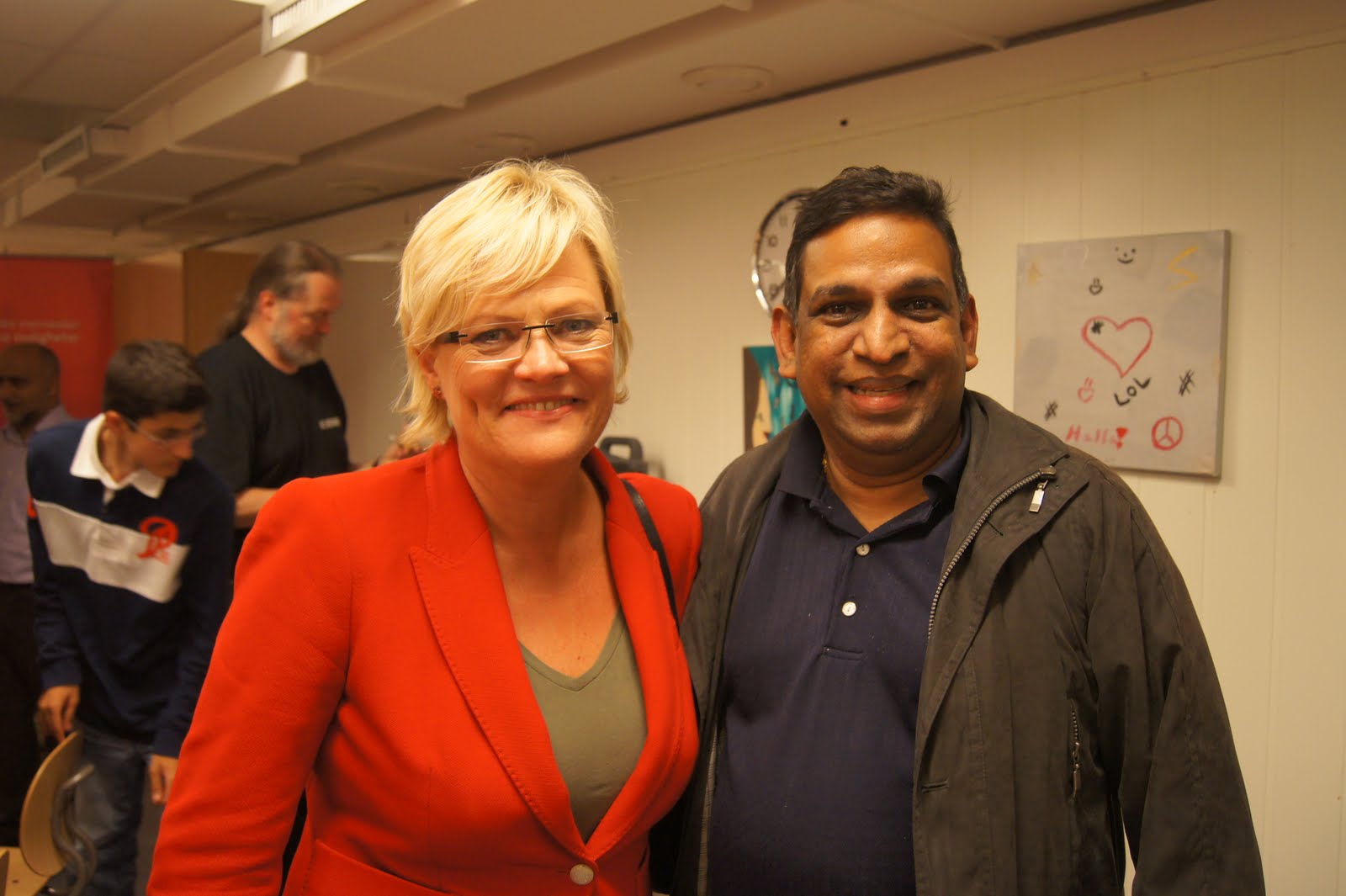
MEETING WITH HON.KRISTIN HALVORSEN, MINISTER OF EDUCATION/NORWAY WITH NEW IDEAS..!!!


DURING THE ELECTION CAMPAIGN AT FJELL SKOLE,DRAMMEN, I MET HON.MINISTER OF EDUCATION: KRISTIN HALVORSEN & SPOKE AT THE PUBLIC MEETING WITH 3 NEW IDEAS OF URGENT NEED:LOCALLY: 1 YEAR JOB TRAINING TO YOUTHS+IMMIGRANTS;NATIONALLY:MONITORING CITIZEN COMMITTEES IN EACH STREET REGARDING NAZI/EXTREME GROUPS/ENVT PROTECTION;INTERNATIONALLY:GON ACTIVE VOICE & INVOLVEMENT IN HR,JUSTICE,FREEDOM,POLITICAL SOLUTIONS,ENVT PROTECTION IN ASIA,AFRICA &LA.I EXPLAINED THE SITUATION IN SRILANKA/TAMIL SUFFERINGS AS WELL AS NEED OF NORWAY'S ACTIVE ENGAGEMENT EVEN DURING POST-WAR PERIOD TOO! ......NSP

Thursday, August 18, 2011

Thirukkural: One of the finest products of Indian culture.! The work of Thiruvalluvar has the unique privilege of being praised EVERYWHERE.!!!


Hinduism

Thirukkural - great treatise on right living
Sinnathamby Rasiah

Thirukkural has been acclaimed as one of the finest products of Indian culture. The work of Thiruvalluvar has the unique privilege of being praised through all the ages and in most countries of the world. If the Tamils were to place before the world audience their literary best, they would definitely place the Thirukkural. There cannot be no disagreement on this point. In the words of well-known modern Tamil poet Subramania Bharathi’ Tamilnad gave unto the world Valluva (the author of Kural) and thereby won great renown’. The master piece of Tamil literature is yet a fertile field for scholars to explore and exhibit the lofty wisdom of the Tamils to the world. Thirukkural is said to be the Bible of the Tamilians and it has been translated into many languages.

World classic of morals
The Kural deals with the essentials of human nature. It has universality of appeal. Its observations goes beyond nationality and languages. Indeed the age of Kural was a period in which many cultures and religions were interacting one upon the other in the Tamil part of the Indian sub-continent. He ‘saw life steadily and saw it whole’ like Shakespeare. He was not a mere observer. He participated in life. He must have lived a rich and abundant life.

Thirukkural

*The Kural deals with the essentials of human nature

*The Kural is a great treatise on right living

*Thirukkural is a book of life

*Thiruvalluvar was a saint

*Thiruvalluvar was a person who had a deep understanding of human psychology


Poet Thiruvalluwar the author of Thirukkural

The Kural is a great treatise on right living. The Kural seems to stand as a unique classic on morals among the ethical works of the world. It is unique due to the fact that its approach to morality is psychological ie. agreeable to the science of psychology. He was concerned about the right and proper way of living at every stage of human growth and development from childhood to old age and development.

Thirukkural consists of chapters which are classified under three main sections viz virtue, wealth and enjoyment comprising of 1330 couplets. It is a book of life – of the whole life. Chapters on ethics politics, economics and human enjoyment are all actuated by one underlying purpose viz the development of human personality in terms of love and compassion.

On virtue
The chapter on virtue consists of 380 couplets dealing on aspects such as righteousness, household life, life’s partner, children, hospitality, pleasant talk, gratitude, impartiality, good conduct, tolerance, benevolence abstinence from flesh, penance, fate and so on.

The first chapter in praise of God deals in a shuttle way without mentioning any religious faith. The theme on rain exemplifies as to how rain is indispensable to all vegetation and livelihood of man. Touching on the theme joy of children Valluvar says begetting intelligent children is the greatest gift and also describes the duties of parents and children. When the mother comes to know that her son is a learned person, her joy knew no bounds than at the time of delivery. On the theme sweet words he draws a similarity to come out with harsh words, when there are sweet words is like plucking unmatured fruits when there are matured ones.

On theme “ideal Householder” he poses the question of what use of a person who tries to seduce the wife of his neighbour. Interestingly touching on the theme abstinence from flesh he asks how could a person be kind if he eats the flesh of another living creature in order to fatten his body. The other topics too are interesting and thee examples are given at random in order to impel the reader to study Thirukkural.

On wealth
The second section of the Kural consisting of 700 couplets deals with the topic of wealth. Wealth is to be produced as it promotes general welfare. Wealth plays a significant part in society; because it is that which gives importance to persons who are otherwise unimportant. But if care is taken to acquire wealth in the proper way, it can become a source of virtue and happiness.

Firstly the chapter on politics deals with the strategies, qualities, duties and statesmanship of a king or ruler. The next chapter on learning is of great interest. What Thiruvalluvar says to learning is of interest not only to rulers but to the ruled also. The following couplet is a striking example on learning.

”Learn without faults, what needs to be learnt; Thereafter conduct yourself in a manner worthy of your learning ‘(Kural-301) While mentioning about perseverance he says” those who strive ceaselessly and undismayed by failure can defeat even fate (KURAL-620)

It is quite interesting that Thiruvalluvar in this section practically deals on all aspects of life which are of utmost importance in the day-to-day life. The importance of acting sensibly is stressed in Kural 423. To whatever one may listen from others it is the intellect that determines the truth. Kural 422 says that in order to encounter difficulties one has to seek the association of great men. Couplet 467, is a striking example on discrimination of things. One should embark on action after careful thought; it is a blunder to think that the mater can be addressed after starting on it.

The requisites for an ideal country are plenty of products, learned men and never decreasing wealth-Kural-731.

Enjoyment
The third section of the Thirukkural deals with enjoyment (Inpam) it relates to love human and love divine. Love is distinguished from lust while love is constant lust is variable. Thiruvalluvar says that the natural beauty of a woman is her excellence of character, her ornaments are her good children she bears.

In married life high moral responsibility is emphasised for raising on a good family. In dealing with the subject on love it underlines the possibility even the necessity to move from sexual life to spiritual life.

After a period of romance and after a period of wedded life, the hero and the heroine having performed all the duties required of them in domestic state, having enjoyed all worldly pleasures are in a state of mind to give their undivided attention to the attainment of bliss, for which their life so far has been a preparation. Once they establish communion with the supreme self they find their sweetness not only in their wife and children but in all things.

Spirituality has a personal as well as a social aspect. It is refreshing to notice that that the spiritual life is described as a joint venture by the hero and the heroine with their relatives around them. The love between the lover and the beloved is compared with the soul and the body. The mystics speak of God as the soul. In Kural 1122 he compares the intimation between the lover and the loved to body and soul.

Thruvalluvar was a person who actually lived his life and also had a deep understanding of human psychology and this is exemplified by Kural 1094.

‘When I look at her, her eyes are turned towards the ground; when I look away she looks on with a timid smile’.

It is not surprising, the author of Kural takes a natural attitude towards sex and life. Thiruvalluvar was a saint. He is said to have lived in the first century of the Christian era. He gave us the famous Thirukkural holy maxims as the Tamil Veda. Whatever its date of its composition Thirukkural has been a source of inspiration for many centuries now.

It is generally listed among the ethical works in Tamil and is considered to be the greatest of them. In the words of Mahatma Gandhi Thirukkural is ‘one of the greatest and purest expressions of human thought’.

DAILYNEWS.LK

Saturday, July 23, 2011

The Mystery Behind the Siva Lingam


The Mystery Behind the Siva Lingam
July 22, 2011, 6:05 pm


K. S. Sivakumaran


A friend of mine asked me why the Hindus worship the Sivalingam enshrined in Hindu Siva Temples. I couldn’t give her a satisfying answer although the phallic symbol represents Lord Siva. I merely told her this as a response to her poser. Reading on the subject I gathered from the Internet some information which I shall share with you.


While some say "the Sivalingam symbol is not a sex symbol and it is an image of Pineal gland in human head", others say:


"Cosmic form of Fire is God. Shiva is worshipped in egg shaped form (Sath, the eternal) better known as Shiva-lingam, which is having egg-shape of a cosmos or the cosmos itself as Vishvamuthi."


Here are few more gleanings on the subject culled from different links on the web:


Worship of the Phallus


According to some scholars, worship of Shiva Linga in effect means worship of the reproduction function. For, they say that the other meaning of the Sanskrit word ‘Linga’ is gender in general and phallus (the male reproductive organ) in particular. They believe that the base of the Lingam corresponds to the Yoni which mean vagina or the female reproductive organ. Correspondence of Linga and Yoni in a Shiva Linga is therefore interpreted as the representation of the process of copulation. Scholars further opine that the Kalash (container of water) that is suspended over the Shiva Linga from which water drips over the Linga also correspond to the idea of intercourse.


Connecting the origin of Shiva Linga to the early Indus Valley civilization, scholars opine" that tribes of the Indus Valley took to the togetherness of Lingam and Yoni in a Shiva Linga as the point of energy, creation and enlightenment. "


Interpretation in Tantra


"According to Tantra, Lingam is a symbol of Shiva’s phallus in spiritual form. They say, the lingam contains the soul-seed within which lies the essence of the entire cosmos. The lingam arises out of the base (Yoni) which represents Parvati according to some or Vishnu, Brahma in female and neuter form according to others."


"Puranas, especially the Vamana Purana, Shiva Purana, Linga Purana, Skanda Purana, Matsya Purana and Visva-Sara-Prakasha attribute the origin of Shiva Linga to the curse of sages leading to the separation of and installation of the phallus of Lord Shiva on earth. Some also refer to the endlessness of the lingam to be linked to the egos of Lord Vishnu and Lord Brahma. "


Interpretation of Shiva Linga as an Abstract Symbol of God


"Some scholars of the Hindu scriptures say that Linga is merely an abstract symbol of the God. They point towards several legends in Hinduism where a sundry rock or even a pile of sand has been used by as a Lingam or the symbol of Shiva. Citing a particular instance they say, Arjuna once fashioned a linga of clay when worshipping Shiva. Scholars of Puranas, thus argue that too much should not be made of the usual shape of the Lingam. Scholars say that the interpretation of Shiva Linga as an abstract form of God is also consonant with philosophies that hold that God may be conceptualized and worshipped in any convenient form. The form itself is irrelevant, as the divine power that it represents is all that matters. Scholars thus say that Sivalinga represent the formless Nirguna Brahman or the formless Supreme Being."


"The Siva Lingam is a sacred symbol of the Hindus whom they revere as the manifestation of the Universal Self in His awakened aspect in union with His dynamic energy Shakti. This prayer is a declaration of faith, obedience, love and devotion to Lord Siva in His aspect as Sivalingam."


Significance of the Shiva Lingam


"The non anthropomorphic Lingam form of Shiva is what is held in reverence in temples all over the sub continent. The Lingam is a symbol. It is a symbol of that which is invisible yet omnipresent. It is hence a visible symbol of the Ultimate Reality which is present in us (and in all objects of creation)."


"The Shivalingam denotes the primeval energy of the Creator. It is believed that at the end of all creation, during the great deluge, all of the different aspects of God find a resting place in the Lingam; Bhrama is absorbed into the right, Vishnu to the left and Gayatri into the heart. The Shivalingam is also a representation of the infinite Cosmic Column of fire, whose origins, Vishnu and Bhrama were unable to trace"


"Legend has it that Parvati fashioned a Shivalingam with a fistful of sand at


Kanchipuram and worshipped Shiva; this lingam is known as the Prithvilingam, denoting the primordial element earth. Shivalingams in several temples are swayambus, or that which appeared on their own, or that which is untouched by a chisel. On the other hand, there are temples where the Shivalingam is carved out of stone and installed. The highly polished Shivalingams of the Pallava period bear several stripes, as in the Kailasanatha temple at Kanchipuram"


"Nandi, the bull is depicted facing the sanctum in all Saivite temples, symbolizing the human soul Jeevatma yearning for realizing its oneness with Paramatma, the ultimate reality."


sivakumaran.ks@gmail.com


www island.lk

Sunday, June 5, 2011

Sri Kailasanathar Swami Devasthanam: The oldest Hindu temple in Colombo,SL.!!!


Sri Kailasanathar Swami Devasthanam:

The oldest Hindu temple in Colombo
By Jajani AMARASEKARA


Sri Kailasanathar Swamy Dewashthanam

The deafening sound of Ketti Melam, music played at Tamil weddings, filled the atmosphere of Sri Kailasanathar Hindu Temple, and the grandly dressed crowd rushed around the kovil to ensure a perfect nuptial ceremony. Not wanting to barge in, we wandered around the place to find the kovil office. A man appeared from nowhere and offered us to help. "Show us the office please?" "Come I will show you," he signalled us to follow. "There, at the blue painted building." We thanked him and followed his directions. We were stunned to see the board 'wedding hall.' The man had assumed we too were invitees. After another round, around the kovil, we found the correct place and managed to meet the kovil officials.


The decorated roof

The astrology chart

A bull statue

The decorated Gopuram
Sri Kailasanathar Swami Devashthanam is a kovil hidden inside a bushy surrounding behind the Fort Railway Station. Built during the Portuguese era, it was a family kovil. Apparently, it is the oldest Hindu temple in Colombo. Although it is Sri Kailasanathar, Swami Devashthanam, many still identify it as the kovil at the Captain's Garden. Though I presumed it as an unseen and unknown kovil, we later realised that it is popular even among non-Hindus. The number of Sinhala notices displayed there makes it obvious.

The entrance to the road leading to the kovil is near the famous second-hand bookstores at D. R. Wijewerdene Mawatha. Turn right from the main road and kovil Veethi, leads to the kovil over the Fort railway lines. As soon as you take a right turn from the kovil Veethi, to the kovil grounds, there are two kovils in the vicinity; a new building and an old colour-faded building. According to the kovil Manager, the faded building is the Ganapathi Kovil and the new-fangled building is the Easwaran Kovil.

Though the two kovils are adjacent the management of the two is different. Construction of a new kovil was under way at the place. A man who hid behind the stone dust was carving beautiful sculptures from the stones brought especially from India. Nowadays with the use of machines, cutting and polishing a stone into a sculpture is an easy task. However, the life of the artisans who originally built the kovil would have undergone many difficulties. The clerk of the kovil office, Nesarajah, took us on a tour around the kovil. Starting from the intricate lotus-carved main door, the tour covered almost all corners of the kovil. As soon as we entered, Nesarajah pointed to the roof. Oh! A gorgeous carving of an astrology chart, adorned the roof entrance. Magnificent paintings of Gods and Goddesses decorated the entire roof of the kovil. The kovil is full of statues of various gods. Shrines dedicated to various gods filled every empty slot of the temple.


The Vel Cart

"Easwaran kovils usually have shrines for almost every god," said the manager. The kovil has shrines for almost every god whom I have read in Tamil folk tales. Sri Kailasanathar Swamy Devashthanam is the starting point of the Vel ceremony, which later went up to Bamabalapitiya on the Galle Road. The kovil has two major festivals, in March and August.

The March festival is dedicated to goddess Pattini, while the August festival is dedicated to God Easwaran.

There is a beautiful Vel cart, decorated with intricate wooden carvings. In June 2010, the kovil Management had organised the most recent Kumbabhishekam ceremony. The kovil offers different special poojas for various gods during the week.

Beginning the week on Monday with a pooja offered to Goddess Pattini, the kovil has a unique set of poojas to Goddess Durga, Bahirawa, and nine planets. On Poya days, the Sri Sakkara Pooja is followed by an almsgiving to the devotees.

The Kannagi Amman festival began on May 25, and it will last for 10 consecutive days, Nesarajah said. The shrines of Goddess Pattini and God Easwaran had two carved bronze flag poles in front.


SUNDAYOBSERVER.LK

Thursday, May 5, 2011

For peace, compassion, and harmony ..!!!


HINDUISM

Chariot festival:

For peace, compassion, and harmony
Chelvatamby Maniccavasagar

The Sri Venkateswara Mahavishnu Devasthanam is situated at Mattakkuliya, Colombo 15 and the annual festival commenced with flag hoisting on April 19 and the chariot festival took place on Sunday May 1. Further, the Board of Trustees has made elaborate arrangements for the success of this festival.

According to historians, 3,000 years before the birth of Jesus Christ, Sri Krishna took a Divine Birth in the Indian city of Madurai. Scriptures call him ‘Purva Avatara’ that is the full manifestation of God. Lord Krishna was a teacher and lover of mankind. He is most accessible to the pure hearted who have cultivated true love for him. The simple, rustic cowherd boys and girls took liberties with Sri Krishna who enjoyed the sport in their company.

Further, Sri Krishna is the greatest Karma Yogi of all times. He was the friend of the poor whom he protected from the oppressors. He was the embodiment of humility. His immortal teachings and Karma Yoga, Bhakthi and Gnana Yoga have no parallel in religious literature.

The Bhagavata Purana, the Vishnu Purana and Maha Bharatha proclaim that there is none to match Sri Krishna in beauty, in wisdom and perfection. His enchanting form with flute in one hand is worshiped by millions in India and Sri Lanka.

In fact, Sri Krishna was the towering genius of his age. He embodied in himself all the great qualities of the head, heart and hand. Every word of his teachings and every act of his life was full of substance and meaning. In the Maha Bharatha battle he was the charioteer to Arjuna and when Arjuna saw his relatives and cousins Duryodanas in the Kurushetra battleground he was reluctant to fight and absolutely paralysed by doubts. At that time, Lord Krishna got rid of his doubt and taught him the immortal teachings of Bhagavad Geetha and enlightened him.

Indeed, Lord Krishna was considered to be the preserver of the universe and he is the object of devotion. He descended to Earth as a great hero to save mankind and establish Dharma. Further, Divinity is like a brilliant chess player making his moves as the giant chessboard of life, unseen and intangible and stimulating man to respond to all his moves. If we make a wrong move, he will not hesitate to counter it. Indeed, all his moves are only to make us as perfect as himself. God may be cunning, but not malicious.


Lord Krishna

Hindu mythology talks about the progress to perfection in an allegorical way as shown by the ten incarnations of Maha Vishnu. His first incarnation was in the goldfish, the second as a tortoise, third as a boar, fourth in the form of Narasinha, fifth incarnation of Lord Vishnu was Vamana, short statured man, the sixth incarnation was Parasurama, seventh incarnation was Balaraman, eighth incarnation was Rama and the ninth incarnation was Lord Krishna to destroy the wicked demons and to take a leading part in the Kumshetra battle between Pandavas and Kauravas. Furthermore, when there is a decline in morality and spirituality and the cosmic order gets disturbed Maha Vishnu will take the form of Kalki Avataram to establish Dharma in the world.

During the Chariot or Ther festival the statue of Lord Vishnu will be decorated and illuminated and taken along the streets in a chariot carved out of pure silver and laden with gold deities and studded with diamonds, rubies, amethyst etc which move slowly from the temple. In fact, Chariot festival symbolizes peace, compassion, harmony and prosperity.

The Chariot symbolizes human body and the statue of Lord Vishnu is the Soul. In front of the chariot are the wooden horses depicted as galloping and the reins attached to their mouth are held on the hands of image of Lord Vishnu.

These horses represent human passion and the reins symbolize the necessity of restraining and guiding these passions. The journey of the Chariot through the streets symbolizes the progress of life. This shows that throughout his life a man must control and guide his passions.

These passions are the motive powers, the driving force of life, but unstrained and unguided they will wreck a man’s life. This is the symbolic meaning of the Chariot Festival.


--------------------------------------------------------------------------------

Thaayumaanavar - a great Saiva Gnani
K S Sivakumaran

About 350 years ago during the Naayakkar Period in South Indian history, a seeker of truth and God, virtually a knowledgeable (Gnani), was working for the king, Muththukrishna Nayakkar who ruled from Thiruchirapalli.


Thaayumaanavar

On his suggestion the king organized a conference of Siddantha and Vedantha scholars primarily to find out from them about the Almighty and related subjects. However, he could not find answers to some of the doubts he had towards religion. He disliked the materialistic life and with earnestness sought knowledge to merge with the Almighty. He came into contact with a sage called Mowna Saami who inspired him. The latter simply told him “Summa Iru” meaning “Just Wait”. This led Thaayumaanavar’s ability to control his thoughts and concentrate ultimate being, the Almighty. Meditation led him to see things better. He could feel that “Maaya”, the Illusion prevents the realization of the real. After the demise of the king Meenaksshi came to power. She innocently enticed Thaayumaanavar to possess him, but he saw in her Maaya and left the kingdom with his disciple Arulaiyah.

However Fate designed a marriage for him and he wedded Kulali of Thirumaraik Kaadu. They had a son named Kanaga Sabapathy. After the demise of his spouse he left his son with Siva Sithamparam Pillai and pilgrimaged seeking ways to renounce the worldly desires. His disciple also followed him.

On his journey progressing as a pilgrim he and his disciple reached Ladchumipuram near Ramanathapuram in Thamilnadu. There he began his Nishdai (deep meditation free from confusing thoughts pointing towards eternal bliss reaching with the Almighty.) More and more disciples surrounded him to receive Thaayumaanavar’s blessings. He yearned to leave this material world to form a constituent part of the Almighty. It happened then when he realized the concept of Monism (Aththuvidam)

The songs and verses of Thaayumaanavar have enriched Thamil Literature. Apart from the deep philosophical findings he learnt through felt experience, his beautiful lines show his scholarship and deep piety. From the beginning of his life he had a spiritual side within him. vakumaran.ks@gmail.com


--------------------------------------------------------------------------------

Significance of cosmic dance of God Shiva
Sinnathamby Rasiah
Shiva the destroyer, protector supreme ascetic and Lord of the Universe. He is Ardhanarishwara half man and half woman The whole life process is imminent in Him, but He transcends it and inhabits a mental, emotional and spiritual space, which is difficult to understand through intellectual process alone. To embrace Shiva, to comprehend His power, involves an intuitive leap into our deepest selves.

Natural phenomena
The cosmic dance of Shiva Natarajah is both symbol and reality. It is the movement of creation, preservation and dissolution. The three activities symbolize the principle of Maya, God’s endless impulse takes place within each of us, within every atom of the Universe. At the end of each yuga, each aeon, the great God in his aspect as Natarajah, dances the death-dance to herald pralaya, the dissolution of the cosmos. At the time of destruction the Universe burns, the element of earth dissolves into water, fire devours the water, water is dissolved into wind, wind gives way to space, the multitudes of Gods dissolved into the unity of Brahman. Then the great Lord separates Prakriti, which is manifest nature and substance, from Purusha or spirit.


Cosmic dance of God Shiva

As Kala-kala, the destroyer of time, Shiva is consumed by the bliss of non-being. Encircled by flames, He restitutes the divine order of the Universe. The drum in His hand heralds the dance of creation just as the ashes smeared on His body signify the forces of destruction ever present in all that is living. The trident of Shiva (Spear with three sharp points) represents the trio of the creator, the preserver and the destroyer.

His spear the pasupatha is the weapon with which he destroys the universe at the dissolution of the yugas, the ordained time circle. God Shiva’s third eye is the eye of fire and symbolizes higher perception throughout past, present and future. A skull signifies Shiva’s power of destruction;n; the crescent moon on HIS head symbolizes his creative power, the Ganga river that flows from his head is a symbol of descending grace. God Shiva’s back left hand holds a blazing fire, the fire god agni, symbolizing his power of destruction samhara, by which the universe is re-aborbed at the end of each-cycle of creation only to be re-created again by God Shiva. This hand represents Na in the Panchakshara mantra, Na-Ma-Si-Va-Ya His planted foot stands for the syllabus Ma and symbolizing His concealing grace Lord Shiva’s left front hand representing the syllable Si held in the elephant trunk pose gajahasta pointing to his left foot source of revealing grace, Anugrakasakti by which the soul turns to him. Left and right back arms are balanced as creation and destruction. Shiva’s back right hand standing for the syllable Va, holds the thin waisted rattle drum, damaru, symbol of creation which begins with soundless sound Paranada from which arises mantra Aum. The front right hand is raised in the gesture abhaya ‘Fear not’, symbolizing Shiva’s power of srihti preservation and protection and standing for syllable Ya.

Lord Shiva’s raised foot symbolizes His revealing grace anugraha sakti, by which the soul ultimately transcends the bonds of anava, karma and maya and realises its identity with Him. He wears a skull necklace. Symbolizing the perpetual revolution of ages. The serpent jahnuwi adorns His body, symbol of kundalini power, the normally spiritual dormant force within man coiled at the base of the spine.

Raised through yoga, this force propels man into God realization. Shiva wears tigers skin, symbol of nature’s power His sash, katibhanda is blown to one side by his rapid movement the arch of flames, prabhavali in which Shiva dances is the hall of consciousness. Each flame has three sub-flames symbolizing fire on earth, in the atmosphere and in the sky. At the top of the arch is Mahakala “great time”. Mahakala is God Himself who creates, transcends and ends time. Shiva Nataraja dances with in the state of timeless transcendence. The double lotus pedestal mahambujapitha symbolizes manifestation From this springs Cosmos.

Realistic
The above is the literal description of God Shiva. It is notable that the cosmic dance of Shiva Natarajah is both symbolic as well as realistic. It has great significance when analysed philosophically as well as scientifically and in the end some sort of similarity between them can be seen.

To amplify further it is appropriate to quote from Art historian Cumaraswamy. Speaking about Shiva’s dance he says “the clearest image of the activity of God which any religion can boast of.” This is from the spiritual point of view whereas scientific explanation is given to the cosmic dance of Shiva Natarajah by Fritjof Capra in his famous book. “The Tao of Physics” He explains Shiva’s Tandava in the context of contemporary understanding. According to him the dynamic view of the Universe as envisioned by the mystic is similar to that of modern Physics. As physics has shown that essential quality of matter is the movement and rhythm and all matter is involved in a cosmic dance, so do we encounter the image in Hindu philosophy as a spirit of nature. The energy dance is in Fritjof Capra’s words “a pulsating process of creation and destruction where not only matter but also the void participates in the cosmic dance creating and destroying energy patterns without end’. It is incontrovertibly as Cumaraswamy has said ‘poetry but none the less science.’

Himself creates, Himself preserves
Himself destroys, Himself obscures
Himself, all these. He does and
Then grants Mukti-Himself the
all pervading Lord” (Thirumantiram)


--------------------------------------------------------------------------------


The annual Ther festival to mark the traditional Sinhala and Hindu New Year was held at the Sri Devi Karumariamman kovil. Here the decorated Ther chariot being taken in procession from the kovil premises around the streets. Pic: A Maduraveeran


A large number of devotees participated in the annual Chariot festival of the Sri Muthu Vinayagar kovil, Sea Street, Colombo 11. The ceremony was organized to mark the traditional Sinhala and Hindu New Year. Here the chariots are being taken in procession around the streets of Colombo city, and the devotees pay their tribute to God Vinayagar by breaking coconuts. Picture A Maduraveeran


The lucky Kala Mandam Kandy organized a felicitation ceremony to honour the members of the Arulmigu Sri Muthumariamman kovil, Wattegama recently, for the contributions they had rendered in their respective fields. Here young member Selvi Kulashika Mahendran receives an award from the President K Sivaraj while kovil trustees’ board members look on. Pic: A Maduraveeran

DAILYNEWS.LK